Description
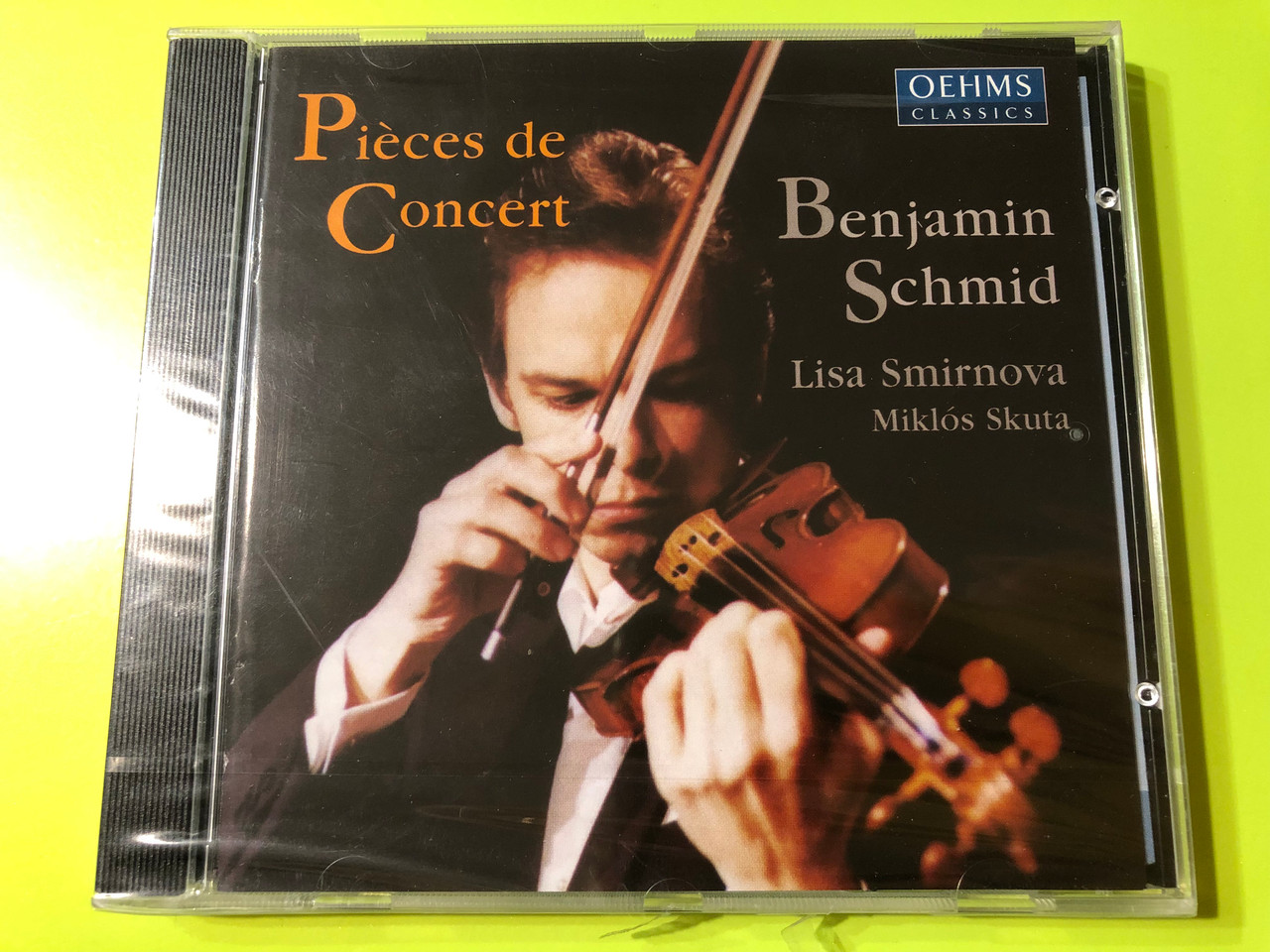
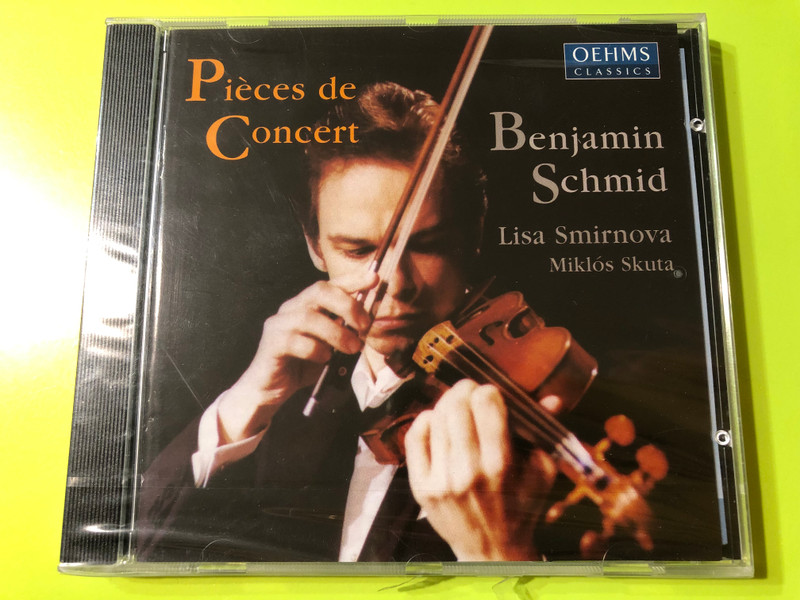
Pièces de Concert: Benjamin Schmid - A Virtuoso Violin Recital CD
Benjamin Schmid violin
Lisa Smirnova piano (Tracks 01–09, 14–16)
Miklós Skuta piano (Tracks 10–13)
Product Details
- Product Type: Music CD
- Brand Name: Oehms Classics
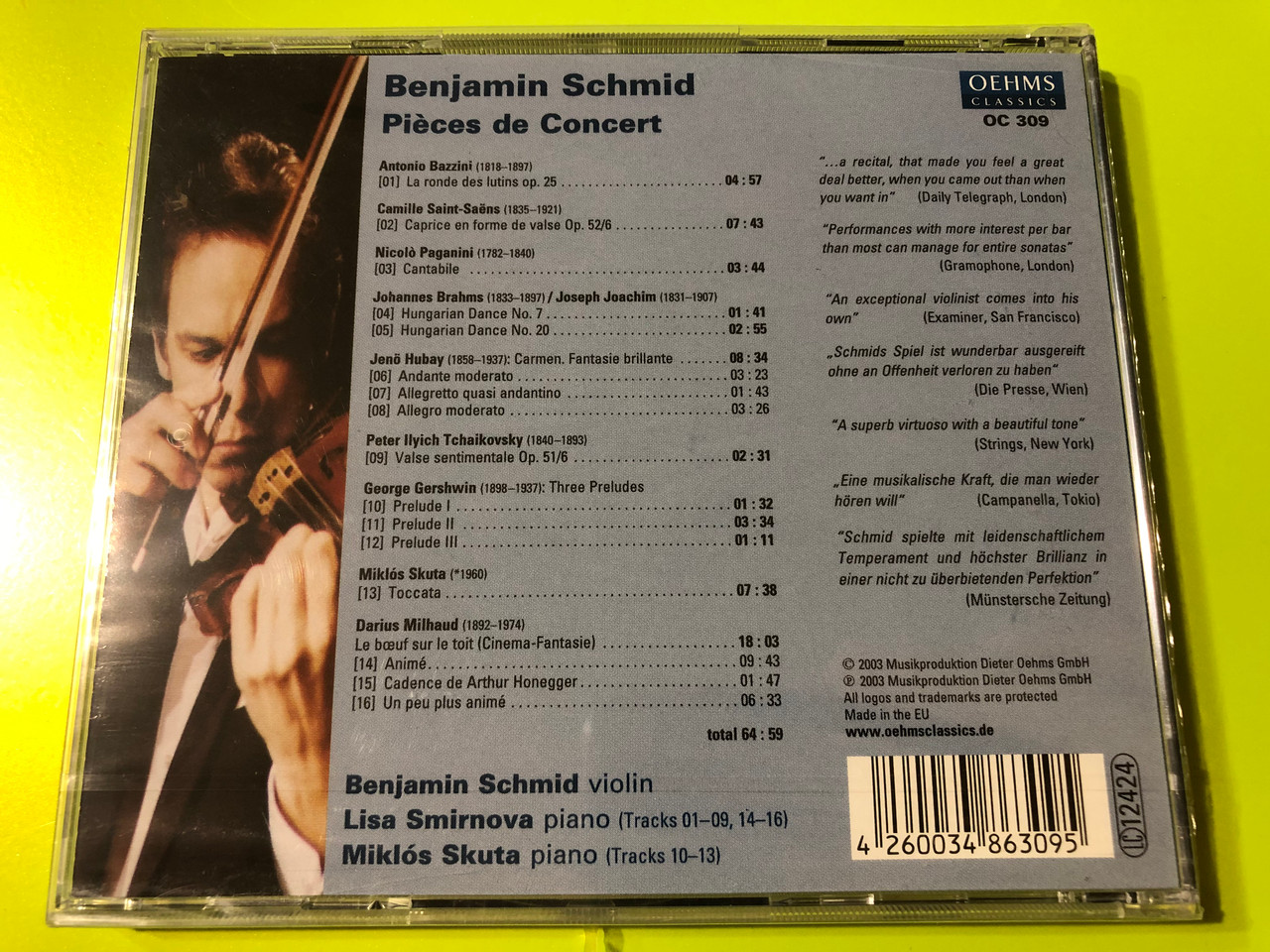
- MPN (Manufacturer Part Number): OC 309
- Label Code: LC 12424
- Genre: Classical Music
- Style: Romantic, Virtuoso Violin Repertoire, 20th Century Classical
- Artists: Benjamin Schmid (Violin), Lisa Smirnova (Piano), Miklós Skuta (Piano)
- Format: Physical CD
- Total Time: 64:59
Overview
"Pièces de Concert" (Concert Pieces) is a captivating classical music album showcasing the virtuosity of Austrian violinist Benjamin Schmid. This Oehms Classics release (OC 309) is a curated collection of dazzling showpieces and beloved short compositions from the 19th and 20th centuries, spanning composers from Niccolò Paganini and Johannes Brahms to George Gershwin and Darius Milhaud.
Schmid is joined by pianists Lisa Smirnova and Miklós Skuta, delivering performances that have been lauded by critics for their technical brilliance and passionate temperament. It is an ideal CD for classical enthusiasts seeking brilliant interpretations of core violin repertoire and fascinating discoveries.
Product Features
- Star Soloist: Features Benjamin Schmid on violin, an internationally recognized artist known for his versatility across classical and jazz genres.
- Diverse Repertoire: The album spans different eras and styles, including pieces by Bazzini, Saint-Saëns, Tchaikovsky, Hubay, Gershwin, and Milhaud.
- Critical Acclaim: Includes quotes from international reviews praising Schmid's "exceptional violinist," "superb virtuoso with a beautiful tone," and playing with "leidenschaftlichem Temperament" (passionate temperament).
- Accompaniment: Features collaborations with pianists Lisa Smirnova (Tracks 01-09, 14-16) and Miklós Skuta (Tracks 10-13).
Interesting Facts
- The Violinist's Praise: Benjamin Schmid's playing is lauded across continents, with Gramophone, London noting his "performances with more interest per bar than most can manage for entre sonatas," and Die Presse, Wien stating his "Spiel ist wunderbar ausgefeilt ohne an Offenheit verloren zu haben" (playing is wonderfully refined without losing openness).
- The Miklós Skuta Toccata: Track 13, "Toccata," is a composition by Miklós Skuta, who is also the pianist for the Gershwin Preludes on tracks 10-12.
- Cinematic Composition: Darius Milhaud’s "Le boeuf sur le toit" is listed as Cinéma-Fantaisie (Cinema-Fantasy), highlighting its origin as music for a surrealist film, adapted here for violin and piano.
- Romantic and Modern Mix: The CD balances lush Romantic works, such as Brahms' "Hungarian Dances" and Tchaikovsky's "Valse sentimentale," with more modern pieces like Hubay's Fantasie brillante and the jazz-inflected "Preludes" by George Gershwin.
Track Listing
- Antonio Bazzini (1818-1897): [01] La ronde des lutins op. 25 . . . . . . . . . . . . . . . . . . . 04:57
- Camille Saint-Saëns (1835-1921): [02] Caprice en forme de valse Op. 52/6 . . . . . . . . . . . . . . . 07:43
- Nicolò Paganini (1782-1840): [03] Cantabile . . . . . . . . . . . . . . . . . . . . . . . . . . . . . . . 03:44
- Johannes Brahms (1833-1897) / Joseph Joachim (1831-1907): [04] Hungarian Dance No. 7 . . . . . . . . . . . . . . . . . . . . . . . . 01:41
- [05] Hungarian Dance No. 20 . . . . . . . . . . . . . . . . . . . . . . . . 02:55
- Jenő Hubay (1858-1937): Carmen. Fantasie brillante [06] Andante moderato . . . . . . . . . . . . . . . . . . . . . . . . 03:34
- [07] Allegro non quasi andantino . . . . . . . . . . . . . . . . . . 03:23
- [08] Allegro moderato . . . . . . . . . . . . . . . . . . . . . . . . . 03:26
- Peter Ilyich Tchaikovsky (1840-1893): [09] Valse sentimentale Op. 51/6 . . . . . . . . . . . . . . . . . . . . . 02:31
- George Gershwin (1898-1937): Three Preludes [10] Prelude I . . . . . . . . . . . . . . . . . . . . . . . . . . . . . . . 01:32
- [11] Prelude II . . . . . . . . . . . . . . . . . . . . . . . . . . . . . . . 03:34
- [12] Prelude III . . . . . . . . . . . . . . . . . . . . . . . . . . . . . . . 01:11
- Miklós Skuta (*1960): [13] Toccata . . . . . . . . . . . . . . . . . . . . . . . . . . . . . . . . . 07:38
- Darius Milhaud (1892-1974): Le boeuf sur le toit (Cinéma-Fantaisie) [14] Animé . . . . . . . . . . . . . . . . . . . . . . . . . . . . . . . . . 09:43
- [15] Cadence de Arthur Honegger . . . . . . . . . . . . . . . . . . . . . 01:47
- [16] Un peu plus animé . . . . . . . . . . . . . . . . . . . . . . . . . . . 06:33
Benjamin Schmid violin Lisa Smirnova piano (Tracks 01-09, 14-16) Miklós Skuta piano (Tracks 10-13)
Publishers
- Record Label: Oehms Classics
- Copyright: © 2003 Musikproduktion Dieter Oehms GmbH
- Publishing Year: 2003
- Origin: Made in the EU
We value your feedback! Share your experience with this product to help others make informed decisions. Your review is important to us!
Hashtags
#BenjaminSchmid #OehmsClassics #PiecesDeConcert #ViolinVirtuoso #ClassicalMusicCD #RomanticViolin #GershwinPreludes #Bazzini #SaintSaens #Milhaud #OC309 #ClassicalCDCollector #VirtuosoRecital
These are pieces played at the end of a concert or as an encore. Compositions which round off a musical menu like a dessert or digestif. Admittedly I am an old-fashioned advocate of such pieces at the end of a programme, because they display an aspect of the violin which is really also a part of the magic of this already so venerable instrument: when musical thought and instrumental realisation form an alliance as equal partners, when the latter is occasionally permitted to outdo the former in attractiveness or brilliance and in the next moment the music again sings alone… when – just for fun – (because fun and art are sometimes – thank goodness – closely allied) very simple musical things are made appealing through highly complicated technical madness and are consequently marvelled at – perhaps with half a wry smile.
The violin is quite simply the most “overdeveloped“ string instrument and has to cope with its role as a pioneer of virtuosity. The most unbelievable things are possible with it: not only is it faster and higher and more overtly emotional than all the others, not only does its palette of tonal nuances range from the softest, most luxurious intonation to a hilarious, spiky staccato, not only does it have the most widely varied tonal modulation possibilities (positively multiplied by two independent “sound producers“ – the left and right hands), thus confirming also in my CD text its reputation as “the instrument which comes closest to the human voice“ (it is claimed that great singers also occasionally learn from great violinists, not only the reverse), but also its potential for “mystical” acoustics can hardly be surpassed: from mellow to piercing, from nebulously darting to martial, from sul ponticello to col legno battuto – and far beyond these – the aesthetics of sound can hardly be more beautiful. Here its diabolical, flashing, mysterious power is demonstrated.
But above all this, it’s greatest strength lies in its ability to combine two sounds most beautifully and with the greatest diversity. Is it not true that the music is often found between the notes, where it cannot be seen on the score, in the gap in an interval?
We violinists and our listeners (“What was that encore?“) want to experience this again and again. And sometimes we enter the virtuoso manége and find that the circus is not only fun, it can also be very stimulating.
All this would mean nothing if it weren’t for the composers and composer-violinists who knew how to combine music and the violin in the most incredible manner. One example is Eugène Ysaÿe (1858–1931), who instantly recognised the violinistic quality of Saint- Saëns’ simultaneously song-like and virtuoso waltz experiments, which need just a couple of timid attempts – and sometimes seem to get stuck in mid-air – before finally breaking out into ecstatic musical turning moments, and along with continuous violinistic feats also equipped them with the most subtle piano dialogue. Or the team of Johannes Brahms (1833–1897) and Joseph Joachim (1831–1907): here the numerous, indescribably brilliant musical ideas (or empathy with a neighbouring idiom – or was it the power of recollection?) in the Hungarian Dances find a worthy arranger for the violin.
In his Cinema Fantasie (effectively the main work in this collection – not only because of its length), Darius Milhaud’s (1892–1974) style is not so violinistic, in part it is even very unpleasant (you don’t necessarily grow up with scales of ninths), but with its wonderfully bizarre overlapping harmonies (comparable with “outside playing“ in jazz), it’s one of my favourite pieces. As well as a lot of original, quirky South American folk music, the themes we hear include an irresistibly nostalgic endless melody; it’s worth sitting through the just under 18 minutes for this alone (in the last third, after the cadenza by Arthur Honegger, which again surpasses the virtuosity of the piece – as if it weren’t already difficult enough).
Jenö Hubay’s (1858–1937) Carmen Fantasy begins almost where the opera stops – quite an original idea, with which it’s possible to steal the show even from Sarasate. Here too we hear the wonderful braggadocio of Escamillo’s song (track 8) – which means one has great fun singing a strangled bass line on the violin. Hubay (of whom I am a direct teacherpupil descendent via Sandor Vegh) also interprets the expression “fantasy“ more freely: he has all kinds of original thoughts. And in the finale he wants to experience it again: for brilliance and virtuosity it can hardly be surpassed.
Then there is a nother waltz: a Valse triste by Peter I. Tchaikovsky (1840–1893), which is particularly captivating because of its melancholy simplicity, brightened only by a tender middle section; but soon again falling back into an even more intimous timidity, to finally prance in a coda over three giant octaves…
George Gershwin’s (1898–1937) Three Preludes have been congenially transcribed for violin and piano by Jascha Heifetz (1900–1987), and naturally they are also numbered among my favourite pieces because of their jazzy texture. The pianist Miklos Skuta and I have been linked for a long time through an approximately equal number of classical and jazz experiences. His Toccata is one of the pieces which he regularly wrote for our duo. I like it because it combines understated rhapsody with minimalism and improvisation, making it a gripping connecting link between our notated and improvised experiences.
On a CD as much concentrated on the violin as this one, of course Paganini must not be missing. Moreover, his Cantabile really does justice to its name and reminds us of what an ingenious inventor of melodies this prototype of a virtuoso was.
The whole thing begins with Antonio Bazzini’s (1818–1897) inevitablbe Ronde des Lutins – I have two explanations for this: firstly it’s one of the best and most amusing encores on the planet, and secondly I would like to be able to give an affirmative answer to the question frequently asked at “post-concert“ CD signings: “Is the last encore on it?“.
“…a recital, that made you feel a great deal better, when you came out than when you want in” (Daily Telegraph, London)
“Performances with more interest per bar than most can manage for entire sonatas” (Gramophone, London)
“An exceptional violinist comes into his own” (Examiner, San Francisco)
„Schmids Spiel ist wunderbar ausgereift ohne an Offenheit verloren zu haben“ (Die Presse, Wien)
“A superb virtuoso with a beautiful tone” (Strings, New York)
„Eine musikalische Kraft, die man wieder hören will“ (Campanella, Tokio)
“Schmid spielte mit leidenschaftlichem Temperament und höchster Brillianz in einer nicht zu überbietenden Perfektion” (Münstersche Zeitung)