Description
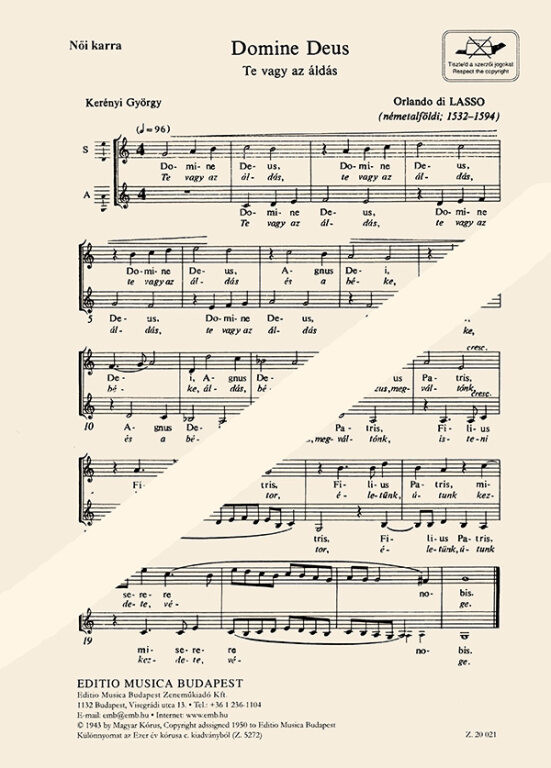
Orlando di Lasso: Domine Deus / Te vagy az áldás – SA Women’s Choir (Bilingual)
Product Details
- ISMN: 9790080200216 / 979-0080200216
- Item Number (MPN): 20021
- Brand/Publisher: Editio Musica Budapest Zeneműkiadó
- Product Type: Choral Score / Sheet Music (Miniature)
- Composer: Orlando di Lasso (Orlande de Lassus)
- Editor: Miklós Forrai
- Translator: Dr. György Kerényi
- Genre: Choral Work, Sacred Music, Renaissance Motet
- Setting: Upper Voices (a cappella)
- Instrumentation: SA (Soprano, Alto or two Soprano parts)
- Period: Renaissance
- Language: Latin, Hungarian (Bilingual Score)
- Length: 2 pages
- Format: Paperback, JB/5 (18.2 x 25.7 cm)
- Country of Origin: Hungary
Overview
This is a precious miniature edition of Orlando di Lasso's Domine Deus (Lord God), arranged and edited for two-part women's or children's choir (SA). Lasso, one of the greatest composers of the Renaissance, is celebrated for his profound motets, and this work is a perfect example of his ability to craft expressive and devout sacred music.
The score, published by Editio Musica Budapest, is meticulously edited by the distinguished conductor Miklós Forrai, and features a dual-language presentation: the original Latin text (Domine Deus) and the Hungarian translation (Te vagy az áldás - Thou art the blessing) by Dr. György Kerényi. This accessible two-part arrangement preserves the elegant polyphonic structure of the Renaissance original while making it suitable for high school, church, or community upper-voice ensembles. Its brevity (only 2 pages) makes it an excellent, focused piece for teaching vocal blend and historical style.
Áttekintés (Hungarian)
Ez a kiadvány Orlando di Lasso Domine Deus (Istenünk) motettájának értékes, miniatűr kiadása, amelyet két szólamban, női vagy gyermekkarra (SA) hangszereltek és szerkesztettek. Lasso, a reneszánsz korszak egyik legnagyobb zeneszerzője, mélyen átélt motettáiról híres, ez a mű pedig a jámborságot kifejező szakrális zenéjének tökéletes példája.
Az Editio Musica Budapest által kiadott kottát a neves karnagy, Forrai Miklós gondozta. A kiadás kétnyelvű: az eredeti latin szöveg (Domine Deus) mellett Dr. Kerényi György fordításában a magyar szöveg (Te vagy az áldás) is szerepel. Ez az egyszerű két szólamos feldolgozás megőrzi a reneszánsz polifónia eleganciáját, miközben alkalmassá teszi középiskolai, templomi vagy amatőr női kari együttesek számára. Rövid terjedelme (mindössze 2 oldal) ideális választás a tiszta hangzás és a történelmi stílus tanítására.
Product Features
- Arrangement for Upper Voices: Specifically arranged for SA (Soprano/Alto or two Soprano parts), making Renaissance music accessible to women's and children's choirs.
- Bilingual Text: Includes both the original Latin (Domine Deus) and the Hungarian translation (Te vagy az áldás) for performance flexibility and deeper textual understanding.
- High-Quality Editing: Prepared by Miklós Forrai, a Hungarian choral conducting legend, ensuring pedagogical and performance excellence.
- Concise and Focused: Just 2 pages in length, perfect for a short liturgical offering, an introduction to polyphony, or ensemble warm-up.
- Octavo Size: Printed in a convenient JB/5 format for easy handling during rehearsals and performance.
Interesting Facts
- The Editor Miklós Forrai: Miklós Forrai (1913–2007) was a central figure in Hungarian choral life, known for his work in spreading the joy of singing and editing a vast amount of choral music for practical use. His involvement guarantees the arrangement is both musical and pedagogically sound.
- Translator Dr. György Kerényi: Dr. György Kerényi (1902–1973) was a prominent Hungarian musicologist and collector of folk songs. His translations often feature in Hungarian editions of sacred music, bridging the gap between historical Latin texts and the local performing tradition.
- Renaissance Simplicity: While Lasso is known for complex eight-part works (like the Stabat Mater), he also wrote smaller, more intimate pieces. This SA setting likely stems from a piece with few original parts or is a highly effective arrangement to highlight the clarity and grace of his melodic lines.
- Thematic Significance: The piece’s title, Domine Deus (Lord God), immediately places it within the realm of profound Christian devotion, typical of the motet genre in the Renaissance period.
Érdekességek (Hungarian)
- Forrai Miklós szerepe: Forrai Miklós (1913–2007) ikonikus alakja volt a magyar kóruséletnek, aki jelentős munkát végzett a kórusmuzsika népszerűsítésében. Szerkesztői munkája garantálja a kotta zenei és pedagógiai hitelességét.
- Kerényi György fordítása: Dr. Kerényi György (1902–1973) zenetudós és népdalgyűjtő munkája a magyar zenei kultúra számára felbecsülhetetlen értékű. Fordítása révén a latin nyelvű szakrális művek szövege a magyar közönség számára is érthetővé válik.
- Egyszerű Polifónia: Ez az SA hangszerelés lehetőséget ad az egyneműkaroknak a reneszánsz polifónia letisztult, kecses dallamvilágának elsajátítására.
Publishers
Editio Musica Budapest Zeneműkiadó Published in Budapest, Hungary. This miniature score, with its focus on pedagogical utility and dual-language text, reflects EMB's dedication to serving the global and local choral communities.
We value your feedback! Share your experience with this product to help others make informed decisions. Your review is important to us!
Hashtags
#LassoDomineDeus #TeVagyAzÁldás #WomensChoirMusic #SAChorus #RenaissanceMotet #SacredMusicScore #EditioMusicaBudapest #MiklósForrai #KerényiGyörgy #BilingualChoral #ChoralPolyphony #UpperVoices #ChurchChoirMusic #BuySheetMusicOnline