Description
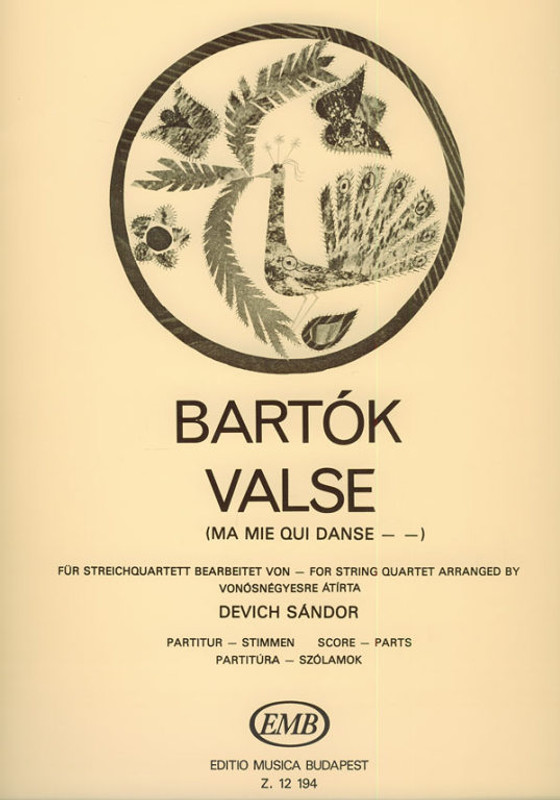
Béla Bartók: Valse (Ma mie qui danse...) for String Quartet – Chamber Music Transcription from the 14 Bagatelles
Product Details
- Product Type: Sheet Music / Score and Parts
- Composer: Béla Bartók
- Original Work: 14 Bagatelles for Piano (BB 50)
- Arranger/Transcriber: Devich Sándor
- Brand/Publisher: Editio Musica Budapest Zeneműkiadó
- MPN (Item Number): 12194
- ISMN: 9790080121948 / 979-0080121948
- Genre: Classical, Chamber Music, Transcription
- Setting: String Quartet (Violin I, Violin II, Viola, Cello)
- Period: 20th Century Composition (Original 1908)
- Language: Hungarian, English, German
- Publication Year: 1982
- Country of Manufacture: Hungary
Overview
This edition presents an elegant chamber music arrangement of Béla Bartók's Valse (Bagatelle No. 4), originally composed in 1908 as part of his groundbreaking 14 Bagatelles for piano. Transcribed for String Quartet by the esteemed musician Devich Sándor, this piece is a perfect addition to the repertoire of intermediate to advanced ensembles.
The Bagatelles mark a pivotal point in Bartók's stylistic evolution, moving away from late-Romanticism towards a modern, folk-infused, and often acerbic musical language. The Valse is characterized by its evocative French subtitle, "Ma mie qui danse..." ("My darling who dances..."), and is celebrated for its harmonic simplicity combined with its rhythmic vitality, offering performers and listeners alike a charming, yet technically engaging, musical experience. This volume includes the complete score and separate instrumental parts.
Áttekintés (Hungarian Overview)
Ez a kiadás Bartók Béla Valse (4. bagatell) című darabjának elegáns kamarazenei átiratát tartalmazza, amely eredetileg 1908-ban, úttörő 14 bagatell zongorára című sorozatának részeként született. A neves zenész, Devich Sándor által vonósnégyesre átírt mű tökéletes kiegészítője a közép-haladó és haladó együttesek repertoárjának.
A bagatellek fordulópontot jelentenek Bartók stílusfejlődésében, elmozdulva a kései romantikától egy modernebb, népi ihletésű és gyakran savanykásabb zenei nyelv felé. A Valse-t az evokatív francia alcíme, a "Ma mie qui danse..." ("Kedvesem, aki táncol...") jellemzi, és harmonikus egyszerűsége, valamint ritmikus életereje miatt ünnepelt. Ez a kötet tartalmazza a teljes partitúrát és a különálló szólamokat is.
Product Features
- Format: Paperback score and separate parts, K/4 format (23.5 x 31 cm) for ease of reading during performance.
- Page Count: 18 pages (Score and Parts combined).
- Instrumentation: Complete set for String Quartet (2 Violins, 1 Viola, 1 Cello).
- Difficulty: Suitable for advanced students and professional ensembles.
- Language: Trilingual introduction (Hungarian, English, German).
Interesting Facts
- The 14 Bagatelles (BB 50): The original piano pieces are considered Bartók’s Opus 6 and represent his final break with traditional harmony, influenced heavily by Debussy and his own research into rural Hungarian folk music. Bartók famously stated that in the Bagatelles, he showed the door to the Romantic era.
- The Transcriber: Devich Sándor (1928–2016) was a highly respected Hungarian violinist and music professor. He was a founding member of the world-renowned Bartók String Quartet, a group dedicated to the performance and preservation of Hungarian chamber music. His close association with Bartók’s work ensures the transcription is authentic and deeply informed by performance practice.
- Harmonic Innovation: The Valse, despite its traditional title, uses dissonant intervals and unusual melodic phrasing that challenge the listener's expectations of a typical 19th-century waltz. The subtitle "Ma mie qui danse..." is often interpreted as a nod to Erik Satie, another composer experimenting with brevity and form at the time.
Érdekességek (Hungarian Interesting Facts)
- A 14 Bagatell (BB 50): Az eredeti zongoradarabok Bartók 6. Opuszának számítanak, és a zeneszerző végső szakítását jelentik a hagyományos harmóniával, erős Debussy hatással és a saját, mélyreható magyar népzenei kutatásaival ötvözve. Bartók híresen kijelentette, hogy a Bagatellekben mutatott ajtót a romantikának.
- Az Átíró: Devich Sándor (1928–2016) nagyra becsült magyar hegedűművész és zenetanár volt. A világhírű, magyar kamarazene előadására és megőrzésére elhivatott Bartók Vonósnégyes alapító tagja volt. A Bartók művekkel való szoros kapcsolata garantálja, hogy az átirat hiteles, és mélyen megalapozott előadói gyakorlaton alapszik.
- Harmonikus Innováció: A Valse hagyományos címe ellenére disszonáns intervallumokat és szokatlan dallamfrázisokat használ, amelyek megkérdőjelezik a hallgató elvárásait egy tipikus 19. századi keringővel szemben. A "Ma mie qui danse..." alcímet gyakran Erik Satie-ra tett utalásként értelmezik, aki szintén a rövidséggel és formával kísérletezett abban az időben.
Publishers
Editio Musica Budapest Zeneműkiadó Published in 1982, this edition from EMB reflects the publisher's long-standing commitment to disseminating Bartók's work in authoritative and performable arrangements. As a leading source for 20th-century Hungarian music, EMB ensures high-quality scoring and scholarly notes in their publications.
We value your feedback! Share your experience with this product to help others make informed decisions. Your review is important to us!
Hashtags
#BartokStringQuartet #ValseTranscription #MaMieQuiDanse #ChamberMusicScore #BartokBagatelles #DevichSandor #EditioMusicaBudapest #ClassicalMusic #HungarianComposer #StringQuartetRepertoire #Vonosnegyes #BartokBela #BuyChamberMusicOnline #20thCenturyMusic