Description
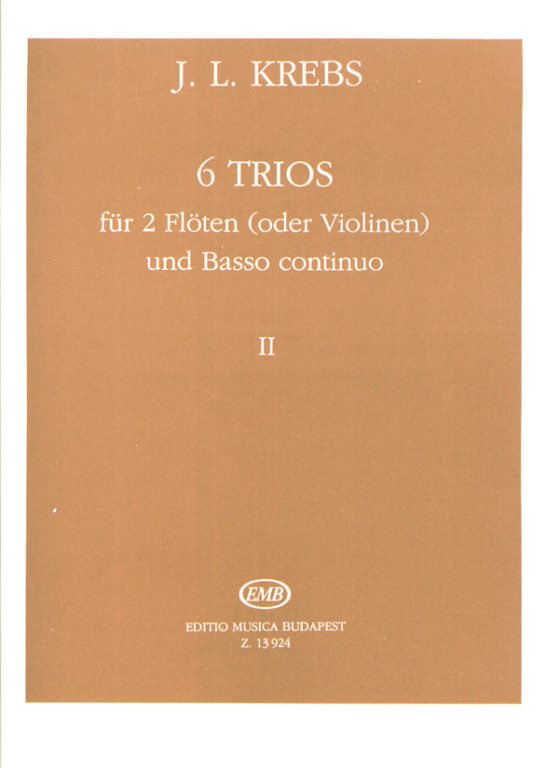
Baroque Chamber Music Rediscovered: 6 Trios for 2 Flutes and Basso Continuo 2 by Johann Ludwig Krebs
Product Details
- Product Type: Sheet Music / Music Score and Parts
- Title: 6 Trios for 2 Flutes (or Violins) and Basso Continuo 2
- Composer: Johann Ludwig Krebs
- Editor: Gyenge Enikő
- Publisher: Editio Musica Budapest Zeneműkiadó
- ISMN: 9790080139240 / 979-0080139240
- Item Number: 13924
- Genre: Classical, Chamber Music, Trio Sonata
- Period: Baroque (Late Baroque)
- Setting: 2 Flutes (or Violins) and Basso Continuo (Piano realization included)
- Format: Paperback (Bach format: 23 x 30.2 cm)
- Pages: 76
- Weight: 0.289 kg
- Year Published: December 1991
- Country of Origin: Made in Hungary
Overview
Experience the sophisticated counterpoint of the late Baroque with 6 Trios for 2 Flutes (or Violins) and Basso Continuo 2 by Johann Ludwig Krebs. This carefully edited collection, published by Editio Musica Budapest (EMB), presents a portion of Krebs’s compelling trio sonatas.
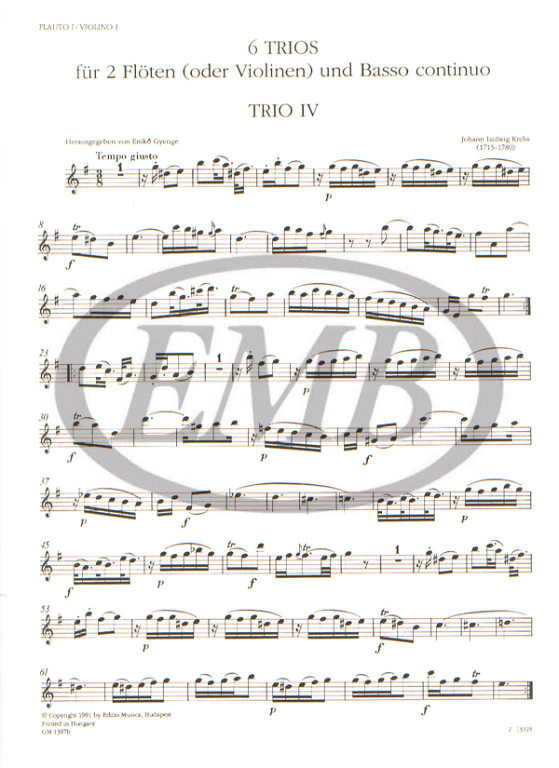
The modern edition, compiled by Gyenge Enikő, is based on a contemporary copy of the work found in the Sächsische Landesbibliothek, Dresden. While the original title specifies "Sechs Trio a 2 Flauti e Basso", the musical material itself suggests the flexibility characteristic of the Baroque era. The editor points out specific musical phrases, such as string turns and double stops in the second melodic part of Trio No. 6, and the wide range up to $G$ in the first trio , indicating that the pieces are also highly suitable for two violins or a combination of woodwind and strings, accompanied by a basso continuo (keyboard realization provided). This volume offers rich, historically informed repertoire for advanced chamber musicians.
Áttekintés (Hungarian Overview)
Élje át a késő barokk kifinomult ellenpontját Johann Ludwig Krebs 6 Triója 2 Fuvolára (vagy hegedűre) és Basso Continuo 2 című gyűjteményével. Ez a Gyenge Enikő által gondosan szerkesztett, a tekintélyes Editio Musica Budapest (EMB) kiadványában megjelent gyűjtemény Krebs lenyűgöző triószonátáinak egy részét mutatja be.
A Gyenge Enikő által összeállított modern kiadás a drezdai Sächsische Landesbibliothekben található mű korabeli másolatán alapul. Bár az eredeti cím "Sechs Trio a 2 Flauti e Basso" megjelölést tartalmazza, maga a zenei anyag a barokk korszakra jellemző rugalmasságot sugallja. A szerkesztő rámutat bizonyos zenei fordulatokra, mint például a vonósfordulatok és a kettősfogások a 6. trió második dallamhangszerénél, valamint az első triószonáta $G$-ig terjedő ambitusára, jelezve, hogy a darabok két hegedűre vagy fúvós és vonós hangszer kombinációjára is kiválóan alkalmasak, basso continuo (zongorakíséret) kísérettel. Ez a kötet gazdag, történelmileg megalapozott repertoárt kínál haladó kamarazenészek számára.
Product Features
- Historically Authentic Edition: Based on a contemporary Dresden manuscript (Mus. 1-Q-1).
- Flexible Instrumentation: Explicitly suitable for 2 Flutes or 2 Violins, or a mixed pairing, with piano providing the basso continuo part.
- Baroque Counterpoint: Excellent study material for developing articulation and ensemble playing in the style of J.S. Bach's students.
- Format: Printed in the standard "Bach" format for clear readability during performance.
- Expert Editing: Edited by Gyenge Enikő, ensuring academic rigor and musical accuracy.
Interesting Facts
- Krebs and Bach: Johann Ludwig Krebs (1713–1780) was one of Johann Sebastian Bach's most talented and favored students. He spent nine years studying with Bach in Leipzig and is celebrated for synthesizing Bach's polyphonic mastery with the emerging Galant style.
- Continuo Realization: The inclusion of a written-out piano part (basso continuo realization) makes this Baroque chamber music immediately accessible to modern ensembles without requiring a specialist continuo player.
- Trio Sonata Form: The Trio Sonata was one of the most popular forms of the Baroque era, typically involving two melodic lines and a bass line (realized by keyboard and often a cello).
Érdekességek (Hungarian Interesting Facts)
- Krebs és Bach: Johann Ludwig Krebs (1713–1780) Johann Sebastian Bach egyik legtehetségesebb és legkedveltebb tanítványa volt. Kilenc évet tanult Bachnál Lipcsében, és azért ünneplik, mert Bach polifonikus mesterművét az éppen kialakuló Galant stílussal ötvözte.
- Continuo Megvalósítás: A leírt zongoraszólam (basso continuo realizáció) beillesztése azonnal hozzáférhetővé teszi ezt a barokk kamarazenét a modern együttesek számára anélkül, hogy speciális continuo játékosra lenne szükség.
- Triószonáta Forma: A triószonáta a barokk korszak egyik legnépszerűbb formája volt, amely jellemzően két dallamvonalat és egy basszusvonalat (melyet billentyűs hangszer és gyakran cselló valósított meg) foglalt magában.
Publishers
Editio Musica Budapest Zeneműkiadó
We value your feedback! Share your experience with this product to help others make informed decisions. Your review is important to us!
Hashtags
#JohannLudwigKrebs #BaroqueMusic #TrioSonata #ChamberMusic #FluteAndViolin #BassoContinuo #SheetMusic #EditioMusicaBudapest #ClassicalMusic #GyengeEnikő #BachStudent #FluteEnsemble #RareBaroqueScore #Kamarazene #Kotta
Hashtags (Hungarian)
#JohannLudwigKrebs #BarokkZene #Triószonáta #Kamarazene #FuvolaÉsHegedű #BassoContinuo #Kotta #EditioMusicaBudapest #BachTanítvány #FuvolaEgyüttes #KlasszikusZene